New Plastics in Design
by Annika FryeHybrid Material Cultures
A growing number of designers have a new understanding of materiality. For them, the design process begins not at the point of product design, but instead with the development of product materials. As many projects show, this is true especially in the realm of plastics, where new perspectives are emerging. Plastics have been a pillar of industrial production since the postwar modern era, and are still emblematic of our culture today. At the same time, though, they also expose and exemplify the greatest problems of this modern era. Plastic, which consists 100 percent of fossil raw materials, has therefore become a symbol of unbridled consumerism. This ends up being reflected in the design of many products. But today the discourse around plastics and their use in design has changed. A new understanding of materials is arising; recycled plastics, for instance, are becoming more highly valued.
To view plastic as something valuable seems at first glance absurd. Plastic waste, which gets heedlessly dumped into the farthest corners of the world by the global West, has become an important and conspicuous symbol of our runaway consumption. Even the tiniest particles of it contaminate our environment and our bodies as microplastics. Nevertheless, we believe that the plastic trash that we collect and sort will at some point get recycled again into a new product. Waste, it is promised, will turn into a resource. And so an industry has materialized around the trade in trash. While China was an important customer for the packaghing waste in our disposal sacks far into the 2000s, the poorer countries of Africa and Asia have now taken over this role. Although we know about these problems, the things we buy in the supermarket continue to be elaborately packaged in plastic casings, which keep becoming more material-intensive. Then again, the image of plastics was not always so bad. Viewed from the perspective of design history, the proliferation of plastics signified new, previously inconceivable freedoms. In the 1960s, plastics were a symbol of breakthroughs, when one thinks of, say, the works of Verner Panton. Plastics (unlike wood, metal and textiles) could be shaped into any kind of form. Back then, plastic was proving itself to be an extraordinarily versatile material. New processes for the production of foam materials and for rotational casting as well as injection molding conquered the market. Plastic was seen as the material of a new democratic product culture; via mass production, it would make good design accessible to all. The shell chairs by Ray and Charles Eames, whose bucket seats were made of fiberglass laminate, were created as that kind of mass product. The plastic was intended to make them durable and at the same time to make an appealing, organic form possible. Today the Eames fiberglass chairs are valuable design classics; they can be repaired and restored, and are traded as rare collector’s items.
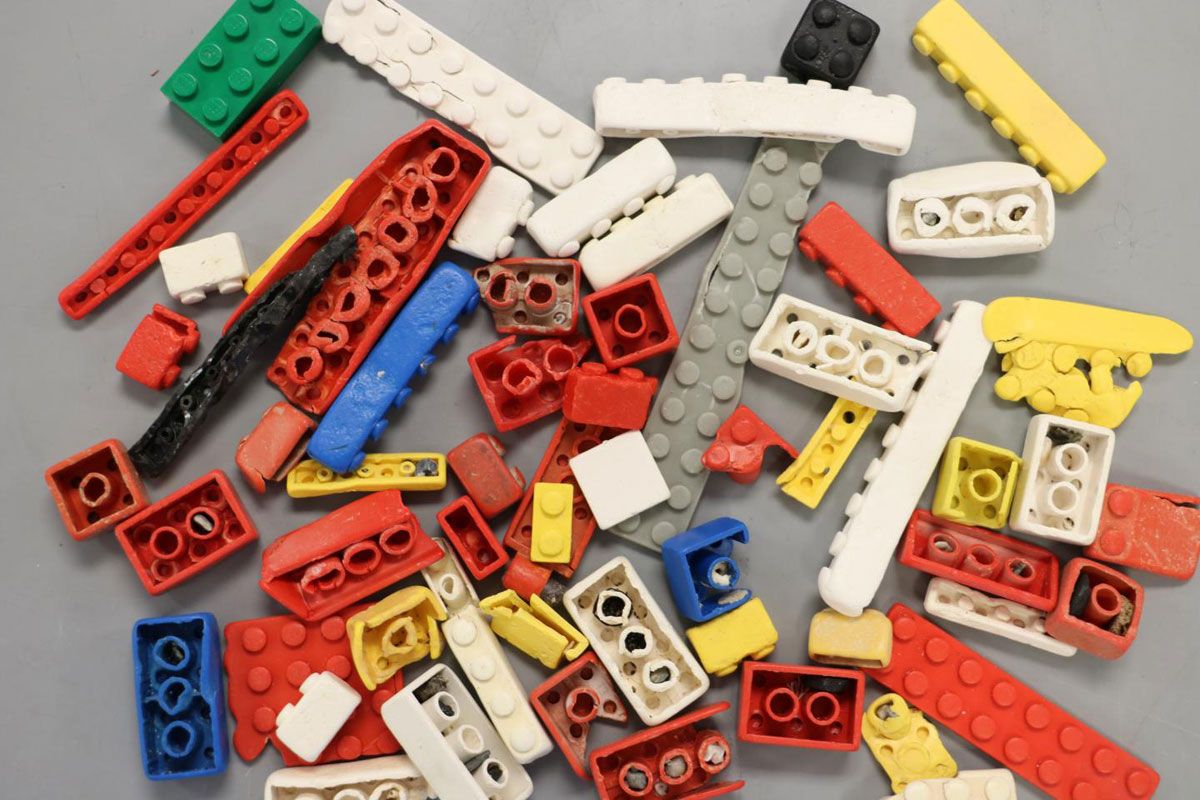
Nowadays, on the other hand, we associate plastics with a lack of quality, with waste and with provisionality. We have forgotten that plastic is a material formulated for durability. Lego bricks, for instance, can last up to 1000 years, as estimated by collectors who have found the bricks along coastlines. A photograph from the Austrian newspaper Standard (Fig. 1) shows Lego bricks that were fished from the sea. These bricks, which are 40-50 years old, look fairly intact. As can be seen in the photo, forms and colors are still recognizable and though the knobs may be somewhat abraded, they are still there. Such permanence is the reason why plastic has endowed us with such an overabundance of waste.
Still, the fact that plastic objects are not perceived to be especially durable lies in the manner in which plastics get fabricated and how plastic products are conceived. For a long time, waste was a blind spot in the field of design. The design industry has scarcely dealt with sustainable materials. Designers are the co-creators of plastic waste. They decide which innovations make it to market, as for instance the design journalist Jasmin Jouhar (2020) writes in relation to furniture design: “Without the engagement of designers and producers, the furniture industry can hardly become more sustainable. Because a major part of the ecological and social costs of a product are determined by design and production.” To really operate sustainably, designers must radically rethink their approach.
Yet it would be reductionistic to see design alone as the driving force behind the problem. The first time design paid attention to questions of sustainability was closely connected with a crisis of functionalism and mass production in the 1970s, which was sparked by questions of participation in design but also by the emerging visibility of environmental destruction. The environmental movement gained ever more supporters; designers no longer wanted to see themselves made into agents of an unchecked consumption of superfluous goods. The task of design should instead be the design of construction plans, which the Whole Earth Catalogue, for instance, gathered together under the slogan “Access to Tools.” At the same time, by putting an image of the Earth seen from the perspective of outer space on its cover, the Catalogue shifted the fragility of the planet into view. It is becoming evident that the methods of design can contribute to the creation of problems – but also to their solution. The paradigm shift in design thrusts the topic of materials to the center of attention. Platforms for designs and experiments with materials are being created, showing not only that a world of sustainable materials is possible, but also shaping interesting design initiatives, for instance the Future Materials Bank (https://www.futurematerialsbank.com/) at the Jan van Eyck Academie in the Netherlands.
What does this mean for design methodology? Initially, a way out of the highly complex system surrounding plastic material seems unimaginable. We are trapped in a construct of technologies, consumer interests, habits, marketing and politics. It’s a classic “wicked problem” – a problem so complex that we will never be able to resolve it. But insight alone into this complexity gains us little. The reduction of complexity – a typical concept in the design theories of late modernism – seems no longer to function. This viewpoint also is inherent in Horst Rittel’s concept of the wicked problem. Furthermore, contemporary approaches to design appear to subscribe rather more to an autopoesis of systems than to a recognition of the hybridity and networked quality of industrial things. Projects that differ in their methodological approaches to design bear in mind the embeddedness of the product within a framework of nature, culture and technology. Consequently, an important step could be to more precisely understand which actors, technologies and methods are effective here. In recent years, the concept of the network has established itself in order to describe these kinds of complex constellations.
For instance, Eva Horn sketches what one such network could be in the geological age of the Anthropocene – the epoch in which, through its activity, humankind is leaving a visible trace as a stratum on Earth. She describes this activity as a cumulative framework of the actions of humans, animals, landscape, seasons, resources, etc. (Horn 2017: 9 f.). In the Anthropocene, waste is a significant aspect of the influence people exert on the network we live in. “Waste, in a broader sense as the materialization of all self-generated byproducts and side effects of human technologies and lifestyles (from CO2 to omnipresent plastic to atomic waste), is increasingly proving itself to be a passive-aggressive opponent not just for humanity, but for the entire framework of life on Earth.” (Horn 2017: 10) The waste we produce ultimately comes back to haunt us.
What does this mean for the practice of design? Two important strategies against plastic waste can initially be designated: valuation and recycling. Most ordinary products made of plastic are designed to use scant amounts of material and as a result, they are not especially durable either. This applies, for example, to packaging such as deep-drawn yogurt cups. In the design process, then, one must already think of how the packaging turns into trash, and then deal as sparingly as possible with the resource of plastic and only use it where it is absolutely necessary. It would be better not to package yogurt in plastic, that’s clear. If and when we use plastic, we ought to comprehend it as something valuable. For instance, Dieter Rams emphasized in his “Ten Principles for Good Design” that the product’s sustainability and lastingness help to create less waste – as for example with the Eames plastic chair (Rams 1995). And durable toys made of plastic, such as Lego, can be passed along, which is why such a large used and collectors’ market has already grown up around Lego bricks.
Once the plastic is in the world in the first place, we must nevertheless still make it clear to ourselves how it will be reused, because the period of time that a product spends as waste far exceeds the duration of its use. We must understand that waste does not mean that an object disappears, but merely denotes an alteration in the context of an object. A plastic bag, say, is never really gone, it merely remains in existence elsewhere. In this regard, landfills are huge storage depots – and at the same time, potential resources. The project Precious Plastic, founded by Dave Hakkens in 2013 in Eindhoven, grasps waste as resource. It foregrounds the quality of recycled plastics. Precious Plastic is a worldwide network of workshops and collection points for recycled plastics. In the home office of the collective in Eindhoven, semi-industrial machines for the reuse of plastic waste are invented, along with new products. (see Fig. 2).
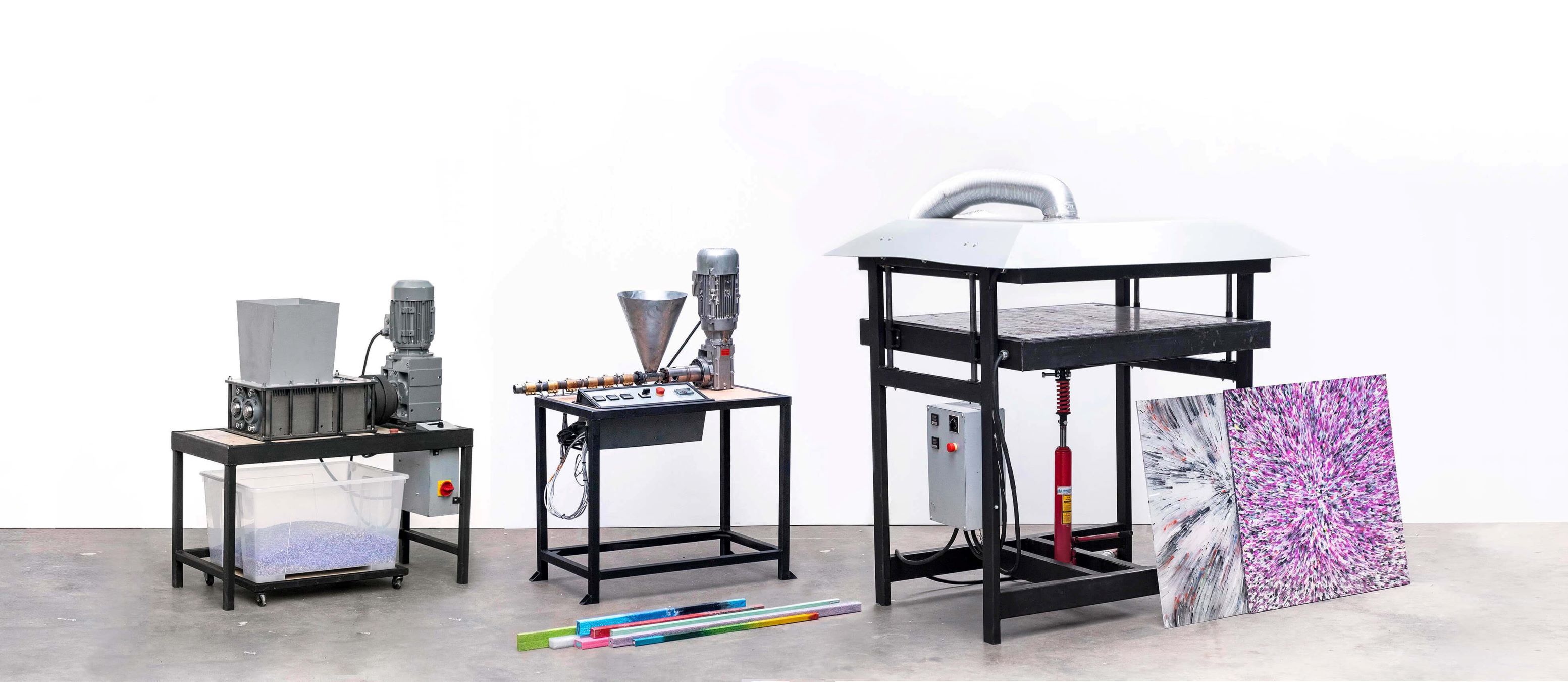
Among the machines are presses for plates made of plastic, extruders, shredders and injectors. However, these only permit certain kinds of plastics to be recycled – that is, thermoplastics – and the materials must additionally be carefully sorted in advance into individual types. Admittedly, large recycling enterprises are already doing this. But the approach of Precious Plastic is to organize the recycling and upcycling locally. To accomplish this, channels of communication are key: numerous videos explain how recycling functions. If one becomes part of the Precious Plastic Community, one gains access to construction plans and additional resources. In contrast to the mainstream industry, which usually separates plastics into only two sorts (polyethylene, or PET, and high-density polyethylene, or HDPE), a local recycling workshop can actually sort plastic into a variety of types. According to Dave Hakkens’ idea, all of us could potentially become part of this project and recycle our waste. The project’s strength lies in the fact that we must all become aware of the potential for change.
Dave Hakkens’ project breaks the whole problematic down into simple parameters. However, when we bring in, for instance, the profitability of recycling as opposed to the production of new packaging, then Precious Plastic must remain an experimental project occupying the niche between the design industry and craftwork. For up until now, in the economic context, finding a way out of the highly complex system existing around the material of plastic seems inconceivable. So, for instance, at a discussion in London in November 2019, the Dutch designer Richard Hutten said that recycling is bullshit (Richard Hutten, quoted in Cogley 2019). As he explained further, he regretted ever having used plastic as a material for his designs. Many of Richard Hutten’s designs, such as his furniture, consist of plastic. Hutten based his view on the fact that plastic design objects are hardly ever recycled – they are burned. Hutten’s point of view reiterates something said by Jan Boelen, who as a curator and the director of the Karlsruhe University of Arts and Design (HfG), is an important voice in the discourse around design. As early as 2018, Boelen, then acting as curator of the Istanbul Design Biennial, made headlines in design media with the provocative thesis “recycling is bullshit.” According to Jan Boelen, only the kinds of plastics that do not have to be recycled in the first place should ideally be made and used (Jan Boelen, quoted in Fairs 2018): “We need a systemic change […] We should change which kind of materials we source, how we manufacture, what we use them for, everything.” What Boelen calls for in fact comes down to a new culture of materiality, which I would like to call “hybrid material culture.” Hybridity in this instance does not refer to the materiality of certain plastic packaging such as Tetra Paks, which represent a problematically insoluble combination of compostable and non-compostable materials. I mean hybridity in a productive sense, that is, as a composite or compound that combines the various qualities (surface, stability, color) of compostable materials.
If one looks at the world of materials with a bit of detachment, one can initially determine that in the Anthropocene, materials can be divided into two kinds: compostable and non-compostable. “We are all compost” – writes Donna Haraway (Haraway 2016b: 101). Compost is meant in the literal sense as a biological process but also as a metaphor for the networking of things. All objects that do not allow themselves to be composted are waste. Back in 1985, in her “Cyborg Manifesto,” Donna Haraway had already described a figure that embodies the hybrid (Haraway 2016a: 3 f.): “A cyborg is a cybernetic organism, a hybrid of machine and organism, a creature of social reality as well as a creature of fiction. Social reality is lived social relations, our most important political construction, a world-changing fiction.” The cyborg is a creature that is an amalgamation of human being, machine and animal. It eludes all categorization and is comprised of technologies and organisms borrowed from disparate worlds. In this area beyond stereotypes, Haraway can dodge the dichotomies of male and female, human and animal, human and machine, etc. The notion of the network and of the interwovenness of human and animal already resonates here – even if the manifesto is typically read as a feminist text and seldom as network theory. Later, in her book Staying with the Trouble: Making Kin in the Chthulucene, Haraway (2016b) further spells out the network concept, making use of the metaphor of a string game whose threads or fibers flesh out a mode of storytelling beyond linearity. She goes on to narrate the story of the “compostists” as a kind of mixture of fact and fiction – SF (science fiction). Compostists are hybrid beings who have made themselves “related to each other” and whose descendants are genetically linked with endangered animal species. They design their bodies in such a way that they are in a position to generate empathy for “critters” – other beings. Haraway sets the tale in the future. After the Anthropocene, human beings in the Chthulucene have developed ways to continue existing on a planet suffering from pollution and inequality. “We are all compost,” (Haraway 2016b: 101), Haraway writes, and thus arrives at the material basis of life and the circulation of materials, in which plastic, the emblematic material of the Anthropocene, is a disruptive factor.
In the final chapter, Haraway’s narrative method is used to present the history of the compostists, while simultaneously summing up the previous chapters that illustrate the hybrid mode of being of human actors. As a material, compost is the veritable embodiment of a good way to understand hybridity. In my opinion, compost forms a contrast to artificial hybrid materials – such as for example a milk carton laminated out of various layers that can never be recycled. Compost serves Haraway as a conceptual image of the hybrid network of human and non-human actors, as a metaphor for the bonds connecting the Earth’s inhabitants, but also as a very palpable summons to pay attention to compost and to design compostables. Haraway explains, “The unfinished Chthulucene must collect up the trash of the Anthropocene, the exterminism of the Capitalocene, and chipping and shredding and layering like a mad gardener, make a much hotter compost pile for still possible pasts, presents, and futures.” (Haraway 2016b: 57).
What does this mean for design processes? How can the idea of composting be made concretely productive for design – apart from that fact that from now on, all products must actually be designed with a view toward their compostability? This change, then, goes beyond mere recycling or the design of lasting products made of plastic. In the material context, we must reconcile apparently incompatible worlds and reconceive processes. Bioplastics are hybrid materials, since within themselves, they seem to combine nature on the one hand and culture on the other. At this juncture, I would like to turn to Bruno Latour, another theoretician who has offered particularly productive scientific-philosophical reflections on design and its problematic separation of nature and culture.
Bruno Latour also makes use of the term “compost” in order to facilitate a description of the hybrid composition of all things and consequently to avoid a distinct separation between nature and culture. According to him, this divide, viewed historically, constitutes the original reason for the problems of modernity, especially the ecological crisis. He advocates this viewpoint in his “Compositionist Manifesto” (Latour 2010). But Latour, unlike Haraway, uses the term “compost” more in the sense of a composition. “Even though the word ‘composition’ is a bit too long and windy, what is nice is that it underlines that things have to be put together […] while retaining their heterogeneity.” (Latour 2010: 473 f.). For him, it’s a matter of bringing things together into a new whole, while the composite continues to retain a heterogeneous structure. He explains that composting also has a meaning that can be associated with the term composition, and that this definitely is interesting because many invisible actors are taking part in composting (Latour 2010: 474). In order to further unpack his concept of composition, Latour goes back to his critique of modernist narratives of progress. Latour says that ‘the modernists’ were actually reductionist, because they trace the determination of that which they call nature back to continuities alone (Latour 2010: 484). But the world is not continuous in its development. He goes on to explain (Latour 2010: 484): “Compositionists, however, cannot rely on such a solution. The continuity of all agents in space and time is not given to them as it was to naturalists: they have to compose it, slowly and progressively. And, moreover, to compose it from discontinuous pieces.” It is interesting, at this point, to see how Latour classifies the roles of creativity and innovation. Creativity, he explains, is intrinsically discontinuous and heterogeneous (Latour 2010: 483). Yet ‘the modernists’ had not understood this, because they mistook innovation for progress. Progress in the sense of modernism, however, was only achieved at the cost of the destruction of the givens. Therefore, we must find a different concept of progress. Interesting here is that Latour (2010: 487) now comes to speak about the aesthetics of composition: “To be sure, it is not a well-composed cosmos, a beautiful and harmonious Pandora Planet, but, as I said, a rather horrendous kakosmos.” Pandora, Latour had explained elsewhere, is the image that the modernists had of their planet. But on the planet Gaia, according to Latour, one could no longer design as before. In view of the networking of all things, the entire attitude to design would have to change (Latour 2010: 487): “It is time to compose — in all the meanings of the word, including to compose with, that is to compromise, to care, to move slowly, with caution and precaution.” In this way, one can say, Latour formulates a comprehensive design theory of hybridity, and situates design in opposition to the modernist narrative of progress.
Thinking the whole situation into the future, this means: Instead of, as until now, creating the new exclusively through the destruction of the old – that is, taking waste for granted – innovation can now integrate the givens, or even better, create a coherent context from heterogeneous individual components. In so doing, this new form of design should be honest in keeping its own heterogeneity visible in the products themselves. Simplification and reduction are actually paradigms of a ‘good design,’ they were and are still relevant for us today. But minimalism for instance, as an aesthetic of formal reduction, has in no way been uninvolved in consumption and mass production. Furthermore, contemporary approaches to design seem to subscribe rather more to an autopoesis of systems than to recognize a hybridity and networking of industrial things.
Nonetheless, all this is not to give the impression that now – as for instance in New German Design – improvised constructions made out of separate and literally visible individual parts ought to be created. Composition, or compost, is much more of a heterogeneous mixture. And in my opinion, materials too could be designed in this way: as hybrid plastics, for instance, whose hybridity is not made up of inseparably combined components that work against reuse, but instead are made to be composted and whose reuse is already inherent in the material itself.
In the context of materials, then, we must reconcile apparently incompatible worlds and rethink processes in new ways. This applies to our dealings with terms and concepts as well. Questions of sustainability and of climate protection repeatedly throw us back into confusing mishmashes of things and meanings, nature and culture, ecology and social relations. In the field of design this is particularly dramatic, since to a large extent, it had previously propagated a modernist viewpoint of the world that presumes a separation of all those realms (see for instance: Simon 1969/1996). Also, the initially productive democratic approach of industrial production – to enable everyone to gain access to design and everyday products under the label “good form” and thus to make a better life possible – seems to us nowadays to be a naïve idea. Instead of the well-intentioned idea that furniture and ordinary objects of high quality should be made accessible to all, the durability of the products has been replaced by the principle of artificial, planned obsolescence. Wolfgang Fritz Haug had already drawn attention to this problem in 1971 in his Kritik der Warenästhetik (Haug 1971, English edition: Haug 1986). The field of design cannot escape its responsibility for these categorical errors and the squandering of resources, work and social stability. It is much clearer today that the previous approaches of classical industrial design have given insufficient consideration to the networks in which they are integrated. Thanks to their participation in massive consumption through commodity aesthetics, those approaches have taken the original notion of design to the point of absurdity – and continue to cling to this point of view.
We must reconcile apparently incompatible worlds and rethink processes in new ways. Bioplastics are hybrid materials, because in them, nature on one hand and culture on the other hand seem to combine. A new aesthetics of artificial materials must be developed. Many questions await us here: How can things be reused? How can they be repurposed? What opportunities for lasting production are there? Finally, how can composting of the plastics be implemented?

Fig. 3: Annika Frye, together with Anna Ulmer and Schierbecker.org, Collage for the design of a compostable bio-compound packaging from algae by-products and PLA (polyactide, a bioactive polyester made up of lactic acid)
Translated by Andrea Lerner
3882 words
Links:
References:
Cogley, Bridget (2019), Plastic recycling is “bullshit” says Richard Hutten at Dezeen Day, Dezeen. https://www.dezeen.com/2019/11/04/plastic-recycling-richard-hutten-dezeen-day/ (accessed: March 28, 2022).
Fairs, Marcus (2018), The rising use of plastic in design is “bullshit” says Jan Boelen, Dezeen. https://www.dezeen.com/2018/09/27/the-rising-use-of-recycled-plastic-in-design-is-bullshit-says-jan-boelen/ (accessed: March 28, 2022).
Haraway, Donna J. (2016a), A Cyborg Manifesto: Science, Technology, and Socialist-Feminism in the Late Twentieth Century, Minneapolis, MN.
Haraway, Donna J. (2016b), Staying with the Trouble: Making Kin in the Chthulucene. Die Verwandtschaft der Arten im Chthuluzän, Durham/London.
Haug, Wolfgang Fritz (1971), Kritik der Warenästhetik, Frankfurt.
Haug, Wolfgang Fritz (1986), Critique of Commodity Aesthetics, Cambridge.
Horn, Eva (2017), Jenseits der Kindeskinder: Nachhaltigkeit im Anthropozän, Merkur 71 (814), pp. 5–17.
Jouhar, Jasmin (2020), Es war einmal ein Joghurtbecher, Frankfurter Allgemeine Zeitung, August 09, 2020.
Latour, Bruno (2010), An Attempt at a “Compositionist Manifesto”, New Literary History 41, pp. 471–490.
Rams, Dieter (1995), Weniger, aber besser: Less but better, Hamburg.
Rittel, Horst W. J. (1992), Planen, Entwerfen, Design: Ausgewählte Schriften zu Theorie und Methodik, ed. by Wolf D. Reuter, Stuttgart/Berlin/Cologne.
Simon, Herbert A. (1969/1996), The Sciences of the Artificial, Cambridge, MA/London.
List of Figures:
Fig. 1: Lego bricks fished from the sea; photo by Andrew Turner. Image citation from: https://www.derstandard.de/story/2000115851524/legosteine-koennen-sich-im-meer-laenger-als-tausend-jahre-halten
Fig. 2: Precious Plastic, Dave Hakkens, workshop, Eindhoven 2020 (klein)
Fig. 3: Annika Frye, together with Anna Ulmer and Schierbecker.org, Collage for the design of a compostable bio-compound packaging from algae by-products and PLA (polyactide, a bioactive polyester made up of lactic acid)